GridShield Platform

Every OT asset. Every CIP standard. One evidence chain.

A Command Center, site Nodes and optional endpoint Agents that collect read-only evidence over OT and network protocols, hash-chain every record, and keep your RSAW worksheets current — entirely inside your network.

Inside the Command Center

The real product, not a mock-up

Captured from a running GridShield Command Center. IP addresses are blurred.
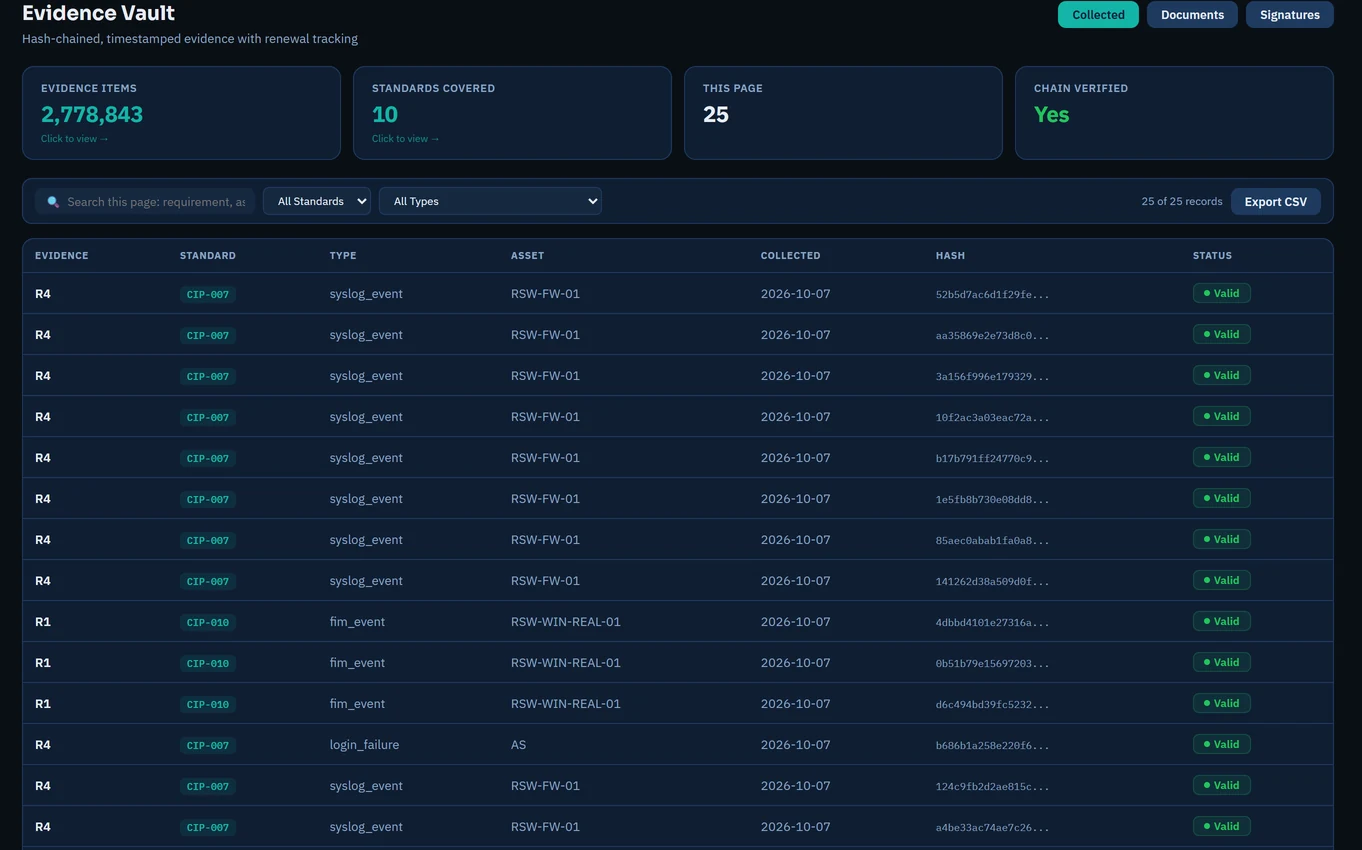
Evidence Vault: millions of hash-chained evidence records with chain verification
Evidence Vault — every record hash-chained, verified and exportable.
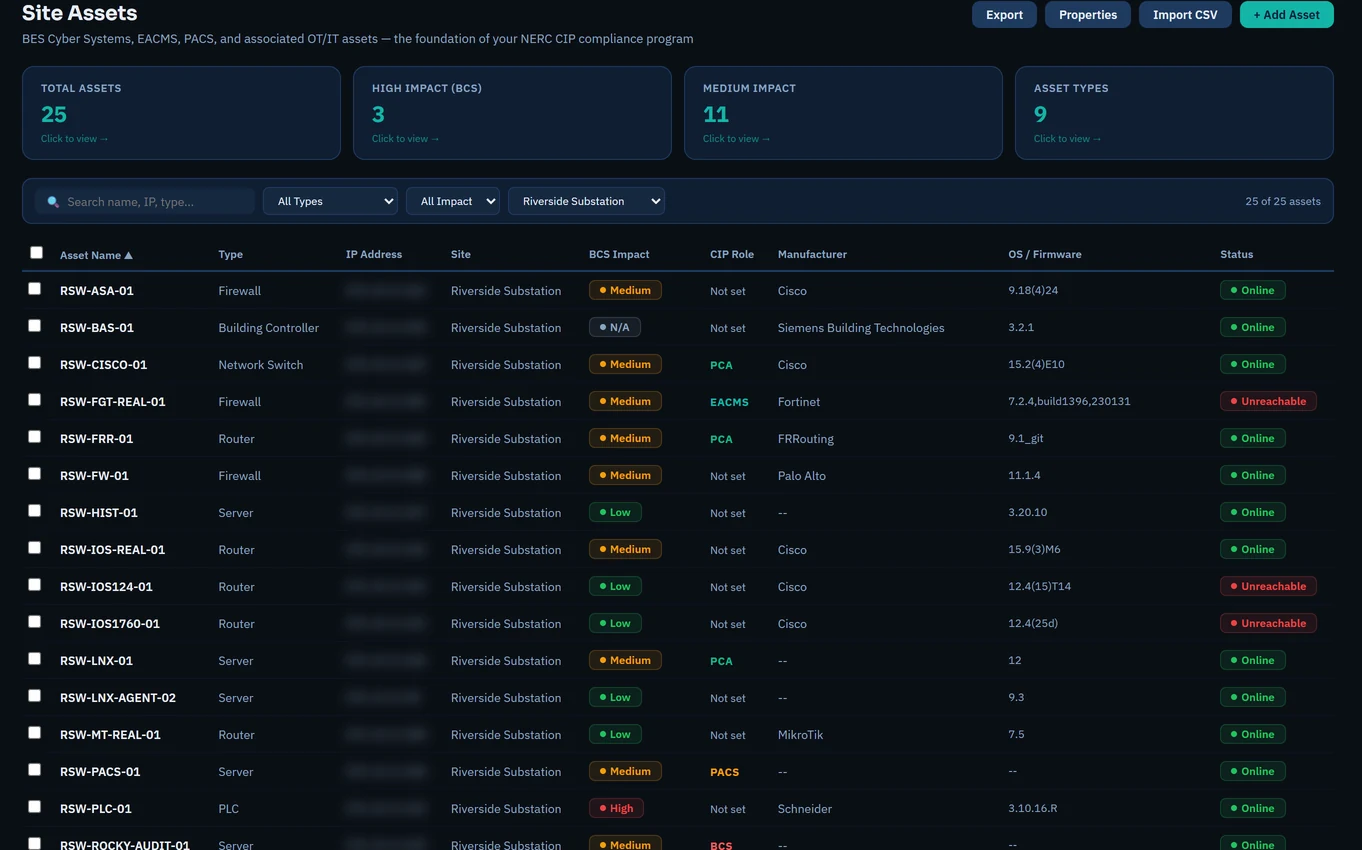
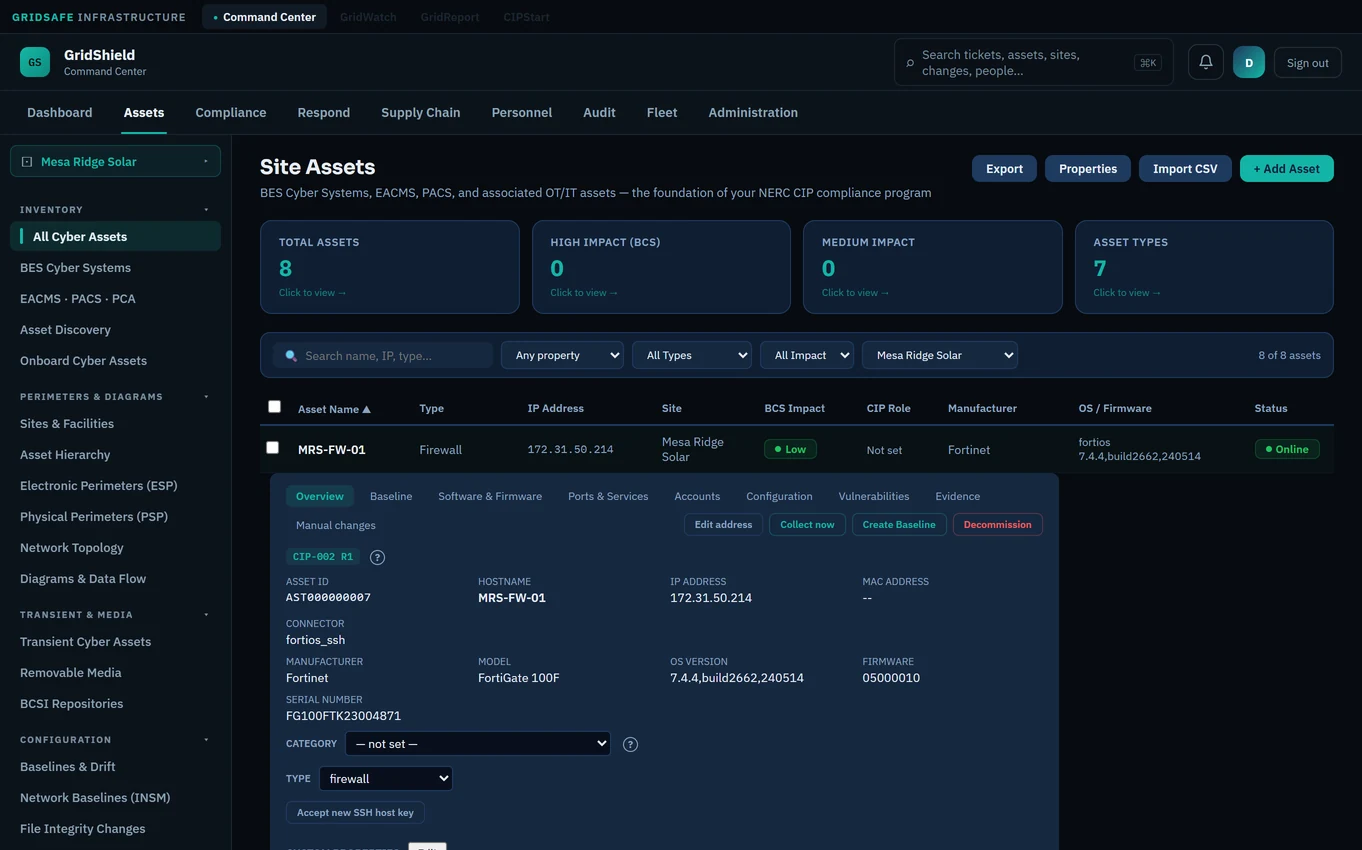
Site asset inventory with BES Cyber System impact ratings and CIP roles
Asset inventory with BCS impact and CIP roles.
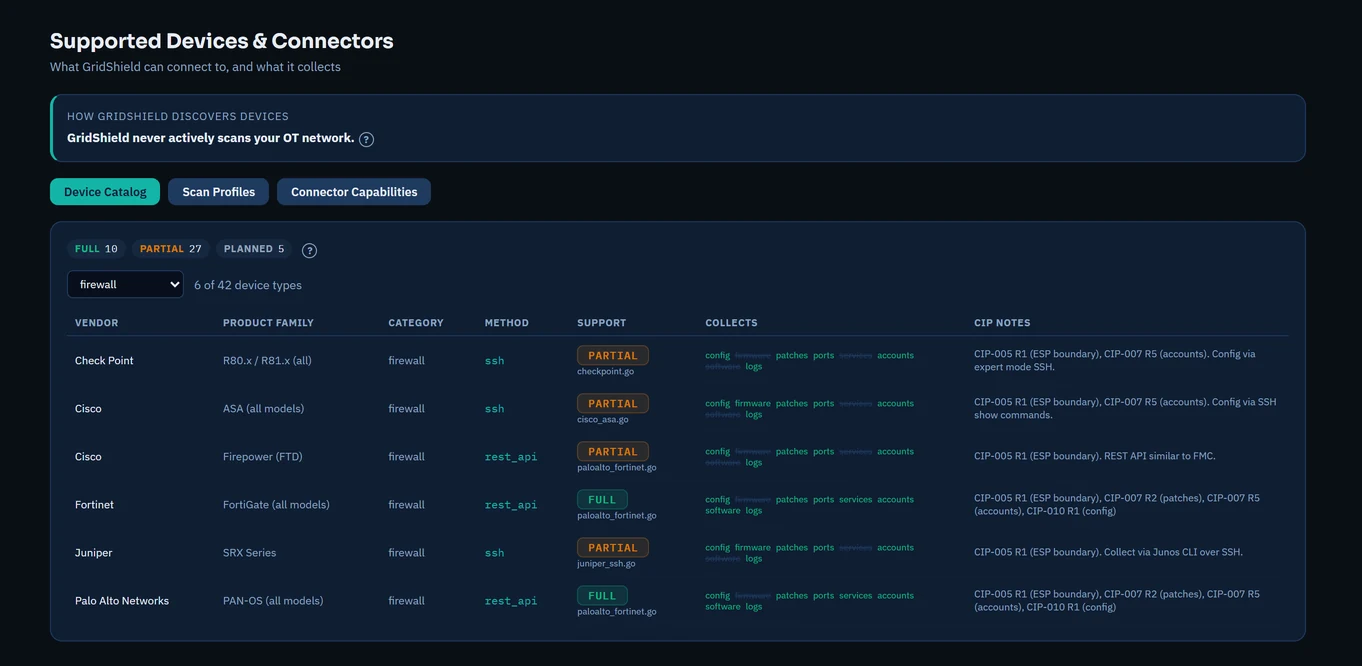
Supported devices catalog showing what GridShield collects per vendor
What GridShield collects, per vendor — stated honestly.
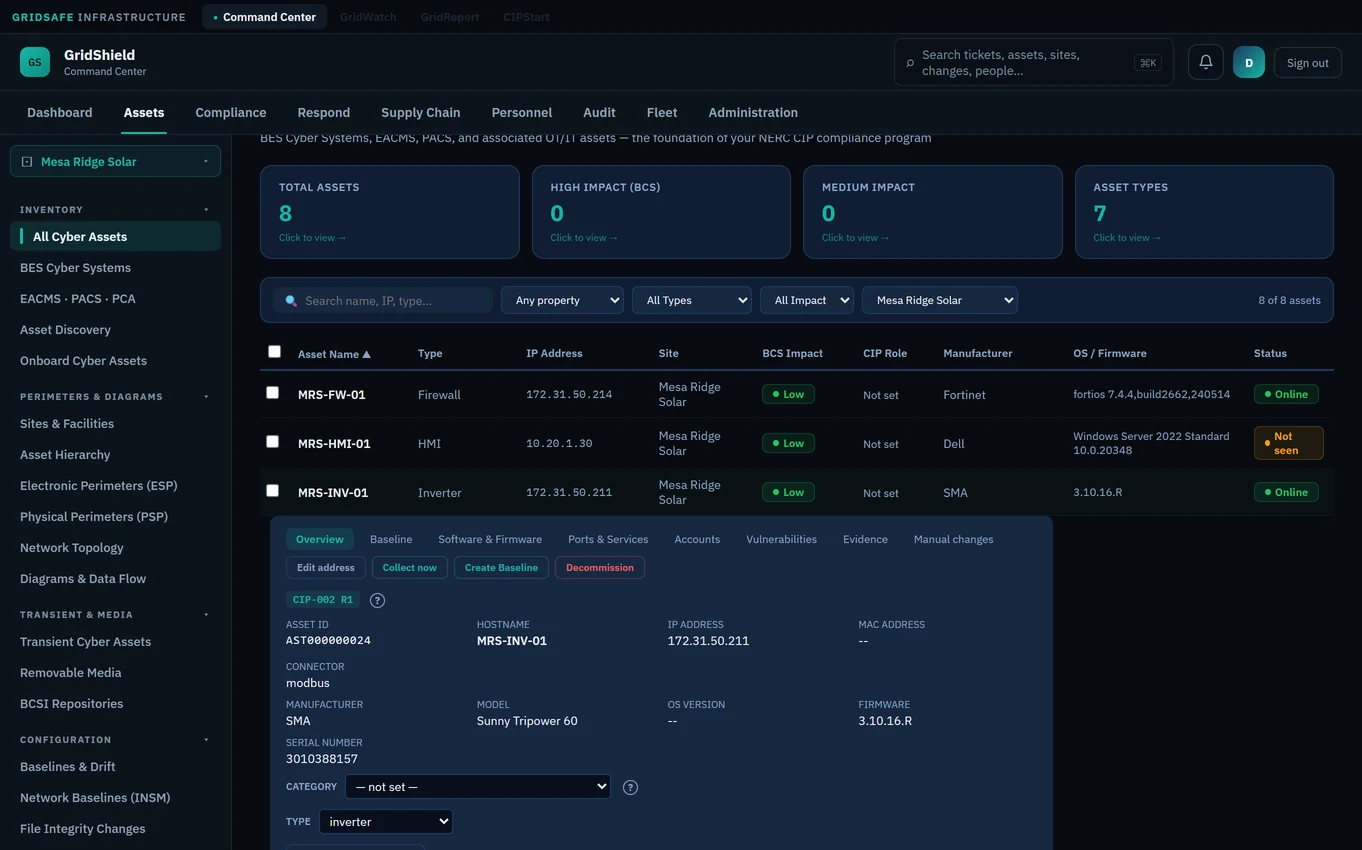
Asset detail for an SMA Sunny Tripower 60 inverter collected over Modbus: model, firmware and serial number
No agent needed: an SMA Sunny Tripower 60 inverter identified over Modbus, with model, firmware and serial collected by a GridShield Node. Demo site: names and addresses are fictional and the inverter is simulated.
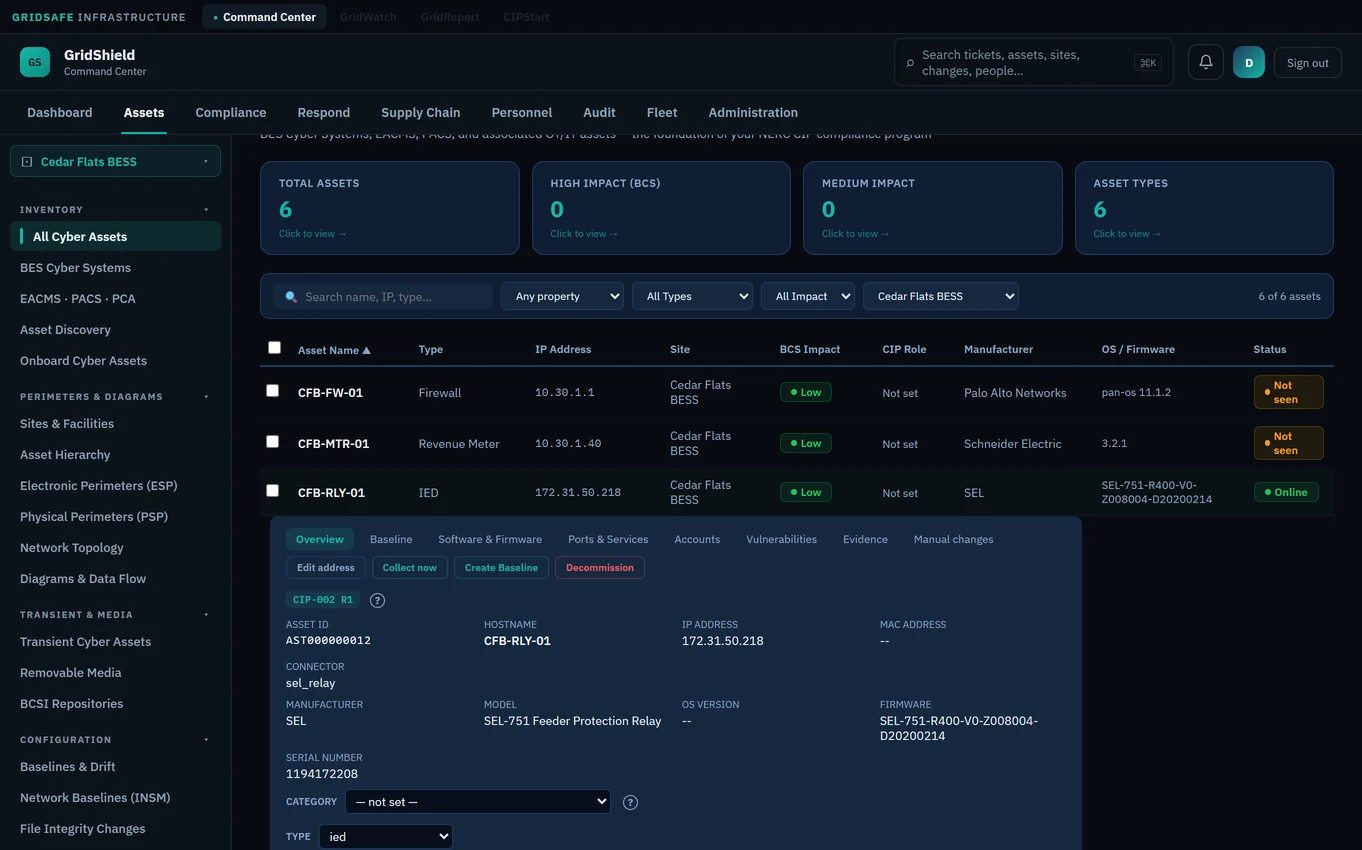
Asset detail for an SEL-751 feeder protection relay: firmware ID, model and serial number read from the relay
An SEL-751 protection relay: its firmware ID and serial read from the relay itself. Demo site: the relay is simulated.
Asset detail for a FortiGate 100F firewall collected over SSH: FortiOS version, model and serial number
A FortiGate 100F read over SSH: FortiOS version, model and serial. Demo site: the firewall is simulated.
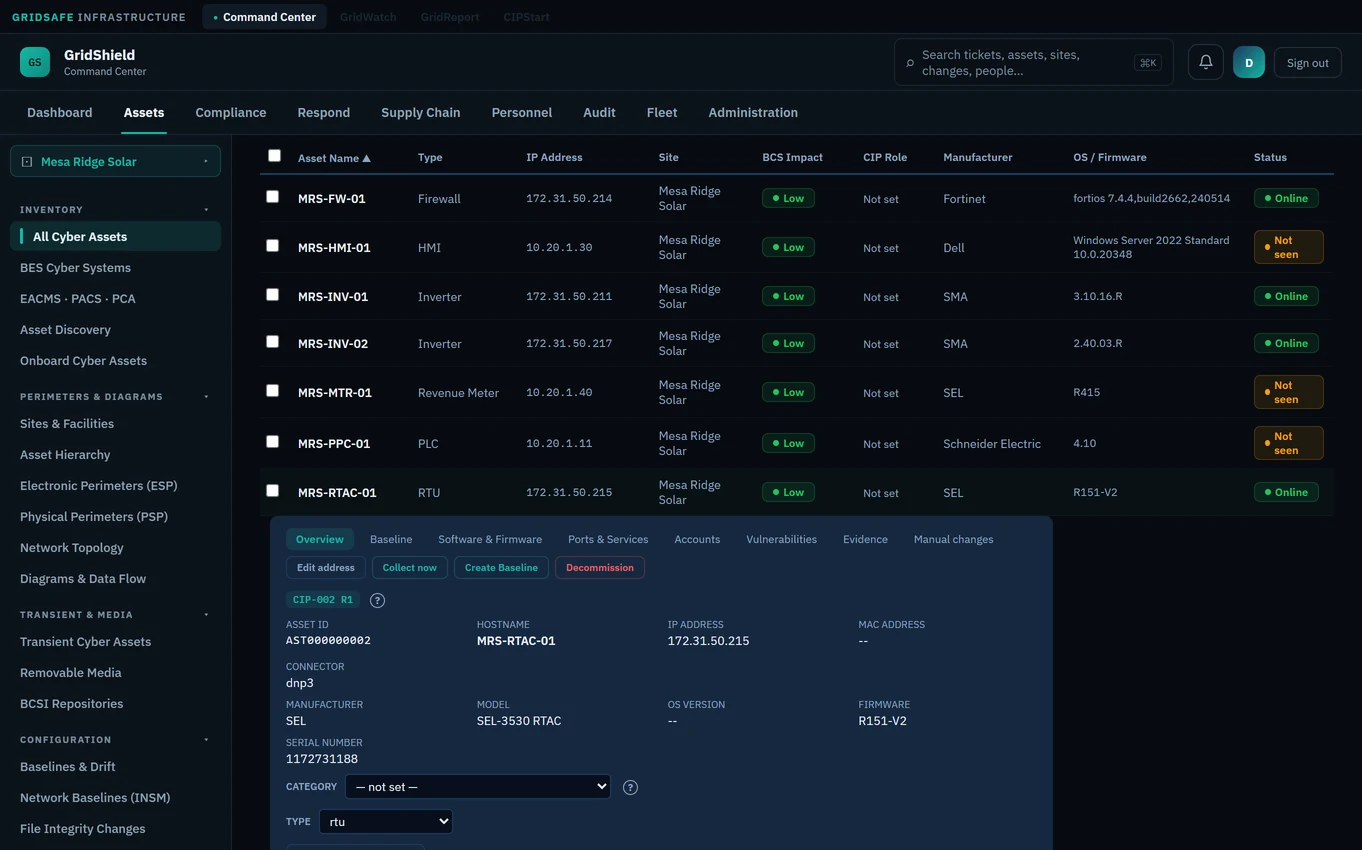
Asset detail for an SEL-3530 RTAC collected over DNP3: model, firmware and serial number
An SEL-3530 RTAC identified over DNP3, with model, firmware and serial. Demo site: the RTAC is simulated.
Architecture

Three tiers, all inside your network

Each tier has one job. Nodes keep collecting through link outages and sync when the connection returns.

Every device is collected read-only, by push, or passively. Nodes talk to the Command Center over mutually authenticated TLS.
Tier 1

Command Center

The central application: asset inventory, Evidence Vault, RSAW worksheets, alerts, change and work-order workflows. Runs on-premises; nothing leaves your network.

Asset inventoryEvidence VaultRSAW worksheetsPrivate CA
Tier 2

Node

A site collector placed next to the assets it watches. It polls devices read-only, receives syslog, SNMP traps and NetFlow, and streams evidence to the Command Center over mutually authenticated TLS — caching locally if the link drops.

mTLS gRPC streamLocal cacheSPAN capture (Linux)
Tier 3

Agent (optional)

A lightweight endpoint agent for Windows and Linux hosts that need deeper evidence, such as file-integrity monitoring. Reports to its Node.

Windows serviceLinuxFile integrity
Collection

How GridShield collects evidence

Native OT protocols, standard network and IT management interfaces, and passive monitoring — all read-only.

OT protocols

  • Modbus TCP (read-only FC3/FC4)
  • DNP3 (read-only polling)
  • BACnet/IP
  • SEL relays
  • IEC 61850 GOOSE (passive)
  • OSIsoft PI

Network & IT

  • SSH
  • WinRM over HTTPS
  • SNMP v2c / v3
  • NETCONF
  • Firewall REST APIs
  • Syslog · SNMP traps · NetFlow

Passive monitoring

  • SPAN / mirror-port capture
  • Write-command detection
  • New-device detection
  • GOOSE replay detection
Security design

Built for the constraints of OT

Safety and isolation come first — in how GridShield collects, how it updates and how it protects evidence.

Read-only by design

Collectors use read functions only. Modbus write codes 5, 6, 15 and 16 and DNP3 select/operate are blocked, and no agent ever issues a control command.

Built for air-gapped sites

Installs from a bootable ISO as a hardened Linux appliance and runs entirely on-premises. Updates arrive as offline packages.

Signed updates, private CA

Updates install only after their GridSafe Ed25519 signature verifies. A built-in certificate authority issues the mTLS certificates every Node and Agent uses.

Tamper-evident evidence

Every record is SHA-256 hash-chained per asset, so any alteration is detectable. The Evidence Vault verifies the chain and exports it for auditors.
High-voltage substation insulators and switchgear
Deployment

From install to evidence in four steps

  1. 1

    Install

    Deploy the Command Center from the ISO inside your environment.

  2. 2

    Enroll Nodes

    Place a Node at each site; it enrolls with the built-in CA and opens an mTLS stream.

  3. 3

    Connect assets

    Add devices and credentials; collection starts on a configurable schedule (default every 5 minutes).

  4. 4

    Evidence & RSAWs

    Evidence lands in the vault, hash-chained, and RSAW worksheets fill in for review.

Compliance

All 14 FERC-approved NERC CIP standards

RSAW worksheets are populated from collected evidence for review by your compliance team. Reference mappings to NIST CSF and IEC 62443 are included.

CIP-002-5.1aBES Cyber System categorization
CIP-003-9Security management controls
CIP-004-7Personnel & training
CIP-005-7Electronic security perimeters
CIP-006-6Physical security
CIP-007-6Systems security management
CIP-008-6Incident reporting & response planning
CIP-009-6Recovery plans
CIP-010-4Configuration change management & vulnerability assessments
CIP-011-3Information protection
CIP-012-2Communications between control centers
CIP-013-2Supply chain risk management
CIP-014-3Physical security (transmission)
CIP-015-1Internal network security monitoring (effective October 1, 2028, U.S.)
Integrations

Fits the tools you already run

Your SIEM

Forward events by syslog in RFC 3164/5424, CEF or LEEF format.

ServiceNow

Raise ServiceNow incidents automatically from GridShield alerts.

Active Directory

Sign in with AD / LDAP accounts, with MFA and role-based access.

CIPStart

Share asset and evidence context with CIPStart, GridSafe's CIP program workspace.

FAQ

Frequently asked questions

No. Collection is read-only: Modbus uses read functions only (FC3/FC4) with write codes blocked, DNP3 polling uses READ only with select/operate blocked, and no Node or Agent issues control commands.
Yes. GridShield installs from a bootable ISO as a hardened Linux appliance and runs fully on-premises. Software updates are delivered as offline packages that install only after their GridSafe Ed25519 signature verifies.
Each evidence record is hashed with SHA-256 and linked to the previous record for that asset. Altering any record breaks the chain, and the Evidence Vault shows whether the chain verifies.
Scheduled collection runs every 5 minutes by default and is configurable per task. Syslog, SNMP traps and NetFlow are received in real time, and SPAN capture is continuous on Linux Nodes.
The product ships a catalog of 42 device types — 10 with full support, 27 partial and 5 planned — and states exactly what it collects from each. Ask us for the current list for your fleet.
Yes. GridShield forwards events by syslog (RFC 3164/5424, CEF, LEEF) and can raise ServiceNow incidents. Users can sign in with Active Directory / LDAP.
At least 4 vCPU and 8 GB RAM. Disk depends on how many assets you monitor and how long you keep evidence: measured, it is about 100 GB for 50 assets and 550 GB for 500 assets per year of retained evidence. We size every deployment with you.

See GridShield on your own assets

A walkthrough configured for your sites, device types and CIP obligations.